🔍 1. Concept & Framework: The Foundation of Control
Definition
An audit is not merely a “checking” mechanism; it is an independent, systematic examination of financial and operational performance. Its goal is to ensure accuracy, compliance, and safety. For senior management, the audit is a tool to evaluate the effectiveness of risk management, control, and governance processes.
The “Three Lines of Defense” Model
It is crucial for a Branch Head or Zonall Manager to understand exactly who owns the risk.
- First Line of Defense: Operational Management (Branch)
- Owner: Branch Managers, Credit Officers, Frontline Staff.
- Role: You own and manage the risk.
- Second Line of Defense: Risk Management & Compliance
- Owner: FGMO/ZO/HO Specialized Departments.
- Role: They monitor the risk.
- Third Line of Defense: Internal Audit
- Owner: Internal Inspectors/Auditors.
- Role: Provide independent assurance.
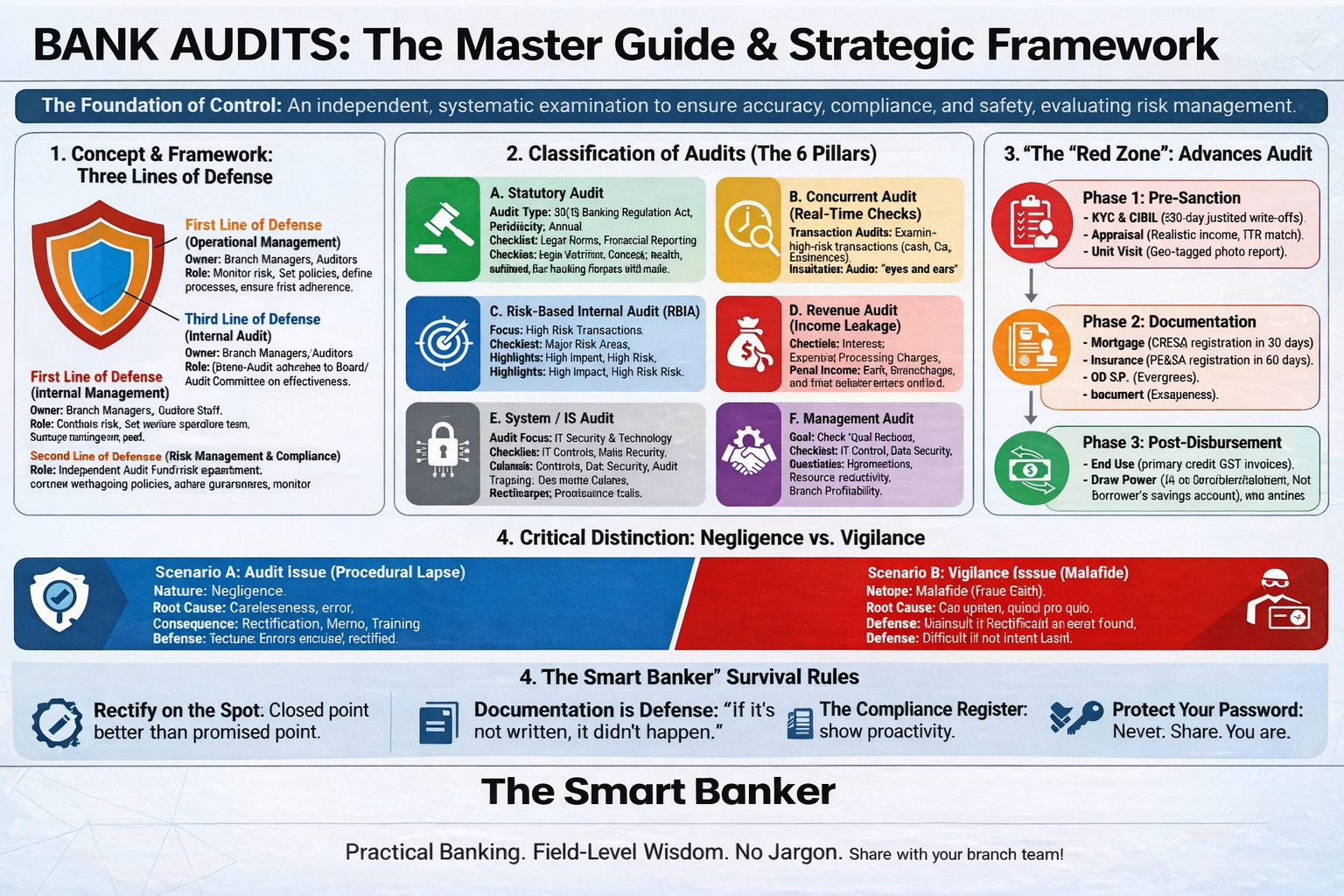
🧾 2. Classification of Audits (The 6 Pillars)
🟢 A. Statutory Audit
- Mandated under Banking Regulation Act, 1949.
- Key Deliverable: LFAR.
- Critical Output: MOC (Memorandum of Changes).
- Impact: Reclassification triggers Provisioning and affects Net Profit.
🟡 B. Concurrent Audit (Real-Time Checks)
- Concept: Examination as the transaction happens.
- Acts as an Early Warning System.
- Auditor liable if negligence is evident.
🔵 C. Risk-Based Internal Audit (RBIA)
- Focus on System/Process Auditing.
- Branches graded Low / Medium / High / Very High Risk.
- High Risk rating impacts performance scorecard.
🔴 D. Revenue Audit (Income Leakage)
- Detect unrecovered charges.
- Processing Charges.
- Penal Interest.
- Forex Margins.
- Locker Rent & GST.
💻 E. System / IS Audit
- Focus on CIA Triad: Confidentiality, Integrity, Availability.
- Password hygiene.
- Access rights & segregation of duties.
- Audit trail monitoring.
👔 F. Management Audit
- Focus on strategic decisions.
- Organizational efficiency.
- HR effectiveness.
- Product profitability.
📂 3. The “Red Zone”: Advances Audit
Phase 1: Pre-Sanction
- KYC & CIBIL validation.
- Income assessment realism.
- Geo-tagged Pre-Sanction Visit Report.
Phase 2: Documentation
- CERSAI registration within 30 days.
- Limitation validity (3 years).
- Insurance with Bank Clause.
Phase 3: Post-Disbursement
- End-use proof.
- Direct payment to Supplier/Builder.
⚖️ 4. Critical Distinction: Negligence vs. Vigilance
Scenario A: Audit Issue (Procedural Lapse)
- Nature: Negligence.
- Example: Insurance renewal missed.
- Consequence: Rectification or memo.
Scenario B: Vigilance Issue (Malafide)
- Nature: Malafide intent.
- Example: Bribe-based sanction.
- Consequence: Suspension / Dismissal / CBI Case.
🛡️ 5. “The Smart Banker” Survival Rules
- Rectify on the Spot.
- Documentation is Defense.
- Maintain Compliance Register.
- Protect Your Password.
Strong controls build strong careers.
Audit is not fear — it is protection.
Audit is not fear — it is protection.